





Germany marks 40 years since Munich Olympics killings
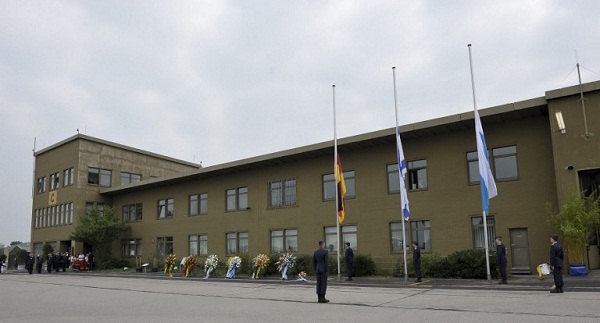
German soldiers put flags of Germany, Israel and Bavaria on half mast during the commemoration of the 40th anniversary of the Munich Olympics Massacre in Fuerstenfeldbruck, southern Germany, on September 5, 2012. Relatives, survivors and politicians paid solemn tribute to 11 Israeli victims of the 1972 Munich Olympics massacre at the site of their killings 40 years ago. On September 5, 1972, gunmen broke into the Israeli team’s flat at the Olympic village, immediately killing two of the athletes and taking nine others hostage to demand the release of 232 Palestinian prisoners. AFP/GUENTER SCHIFFMANN
FUERSTENFELDBRUCK, Germany—Relatives, survivors and politicians paid solemn tribute on Wednesday to 11 Israeli victims of the 1972 Munich Olympics massacre at the site of their killings 40 years ago.
About 600 guests passed security checks to attend a ceremony at Fuerstenfeldbruck air base, west of Munich, where a hostage-taking by members of a radical Palestinian group known as “Black September” reached its tragic climax.
Article continues after this advertisementMany of the guests wore dark glasses and brushed away tears as an ecumenical memorial service got underway to mark the anniversary which has prompted new questions about the turn of events on German soil.
Under grey skies and with flags flying at half-mast, white candles lined a podium over which hung large black and white photos of the Israeli athletes and coaches who were taken hostage and subsequently killed.
“That day wasn’t an attack against Israel, wasn’t an attack against Jews. It was an attack against us all. Against the Olympic idea, the vision of freedom and peace for all human beings,” Charlotte Knobloch, head of Munich’s Jewish community, said, herself also visibly moved.
Article continues after this advertisementAnkie Spitzer, widow of fencing coach Andre Spitzer, German Interior Minister Hans-Peter Friedrich and Israeli Deputy Prime Minister Silvan Shalom were later due to address the commemoration.
The 40th anniversary has given rise to new research into the horrifying chain of events at the summer Munich Games, which were meant to showcase the new face of what was then West Germany nearly three decades after World War II.
On September 5, 1972, gunmen broke into the Israeli team’s flat at the Olympic village, immediately killing two of the athletes and taking nine others hostage to demand the release of 232 Palestinian prisoners.
A bungled rescue operation resulted in all the hostages being killed along with a German policeman and five of the eight hostage-takers.
The news sent shock waves through Germany just 27 years after the Holocaust and opened a deep rift with Israel.
Israeli sprinter Esther Roth-Shachamorov relived the terror in an interview with AFP this week.
“I remember an exhausting and frightening day,” she said.
“We saw the Germans conducting negotiations with the terrorists through the balcony. They were threatening every two hours that if 200 Palestinians were not released, they would throw an Israeli down on the street,” she added.
Henry Hershkovitz, who was on the Olympic shooting team and has returned to the stadium, was quoted Wednesday by the German daily Berliner Zeitung as saying: “We were like a family and most of this family was killed.”
Former fencer Yehuda Weinstain said in the paper: “The Games admittedly went on but their spirit had been murdered.”
Forty years later the events continue to provoke controversy.
Last week, Israel released official documents on the killings, including specially declassified material and an official account from the former Israeli intelligence head, lambasting the performance of the West German security services.
The police “didn’t make even a minimal effort to save human lives”, former Mossad head Zvi Zamir said at the time after returning from Munich.
He said elite German snipers had been equipped only with pistols, and that personnel carriers meant for the rescue operation had arrived late.
“They had no follow-up plan, nor any means of improvising an alternative,” he said.
Meanwhile Hamburg-based investigative magazine Der Spiegel in July accused the government and Olympic organizers of covering up grave mistakes.
Months before the hostage-taking, the interior ministry and the Bavarian state police warned federal authorities in vain of the possibility of “terrorist acts” at the Games, the magazine said.
The Spiegel report recalled that the Olympic village was surrounded by a simple chain link fence without security reinforcements.
The head of the Munich police evidently feared that a robust security presence would revive ugly memories of the 1936 Games in Berlin, presided over by Adolf Hitler.


